Amazon has officially introduced a new generation of Alexa Tablets, marking one of the company’s biggest changes to its tablet strategy in years. Instead of continuing to focus primarily on inexpensive Fire tablets, Amazon is moving toward a more premium experience designed to compete directly with established tablet makers such as Apple and Samsung.
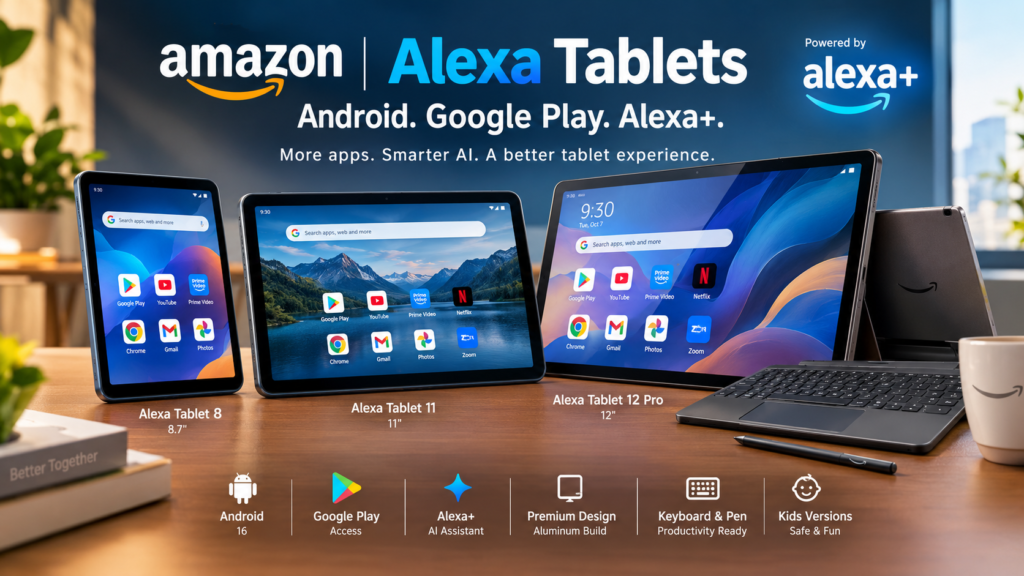
The new lineup combines Android, Google Play Store access, premium hardware, and Alexa+ artificial intelligence. The range includes the compact Alexa Tablet 8, the mid-size Alexa Tablet 11, and the flagship Alexa Tablet 12 Pro. Prices start at approximately $229.99 and reach more than $500 for the highest-end configuration.
This represents a fundamental shift for Amazon. The company is no longer positioning its tablets simply as affordable screens for Prime Video, Kindle books, web browsing, and children’s entertainment. With the new Alexa Tablets, Amazon is attempting to create devices that can handle entertainment, productivity, reading, communication, AI assistance, and everyday computing from one portable screen.
Amazon Alexa Tablets Replace the Traditional Fire Tablet Strategy
For years, Amazon’s Fire tablets were known primarily for affordability. Their low prices made them attractive for families, children, streaming, reading, and basic browsing. However, the Fire tablet ecosystem also had limitations, particularly for consumers who wanted the broader Android application experience available through Google Play.
The new Alexa Tablet family addresses one of the most significant complaints about previous Amazon tablets: Google Play Store availability.
The new tablets run Android and provide access to Google Play, giving users a substantially broader application ecosystem. This makes the devices more practical for people who want to install mainstream Android applications rather than relying primarily on Amazon’s own software ecosystem.
That software change could be more important than the hardware itself. A premium tablet needs a strong application ecosystem, and Amazon’s decision to embrace Google Play makes its new devices much more competitive with conventional Android tablets.
Amazon Alexa Tablet 8: The Compact Option
The Alexa Tablet 8 is positioned as the most portable member of the new family. With an approximately 8.7-inch display and a starting price around $229.99, it provides a smaller alternative for consumers who prioritize portability.
A compact tablet can be useful for reading, web browsing, video streaming, travel, casual gaming, recipes, social media, and smart-home control. Its smaller footprint also makes it easier to carry around the house or place in a bag.
Amazon has retained the idea that tablets should be approachable and practical while giving this new generation a more premium construction and a more capable software platform.
For users who do not need a large productivity display, the Alexa Tablet 8 could become the most convenient option in the lineup.
Amazon Alexa Tablet 11 Offers a Middle Ground
The Alexa Tablet 11 sits between the compact model and the flagship Pro device. With an 11-inch-class display and a starting price around $329.99, it is designed to balance portability with screen space.
An 11-inch tablet is large enough for watching movies, browsing websites, reading documents, attending video calls, using productivity applications, and managing everyday tasks without becoming as cumbersome as a large laptop.
Amazon’s positioning of this model is particularly interesting because it gives consumers a device that can function as both an entertainment screen and a lightweight productivity computer.
The tablet also benefits from the same fundamental software transformation as the rest of the lineup: Android and Google Play access combined with Amazon’s Alexa+ experience.
Alexa Tablet 12 Pro Is Amazon’s Flagship Tablet
The most ambitious device in the lineup is the Alexa Tablet 12 Pro.
With a starting price of approximately $499.99, the 12 Pro is clearly designed to compete in a different category from traditional budget Fire tablets. Amazon has equipped it with a premium aluminum design, a large high-resolution display, powerful hardware, and optional accessories intended for productivity.
The 12 Pro features a large 12-inch-class display, with a high refresh rate and a resolution reported at approximately 2800 × 1840 pixels. Its aluminum construction and slim body give it a much more premium appearance than earlier Fire tablets.
Amazon is also offering a Nanomatte display option, priced higher than the standard version. The special display is designed to reduce reflections and glare, making the tablet particularly interesting for reading, working, and viewing content in bright environments.
The Nanomatte Display Could Be the 12 Pro’s Biggest Advantage
Large glossy tablet displays can be beautiful indoors, but reflections can become distracting near windows, under bright lights, or outdoors.
Amazon’s Nanomatte display takes a different approach. Rather than simply increasing brightness to overcome reflections, the display uses a specialized surface intended to reduce glare while maintaining image quality.
That makes the technology particularly appealing for people who use a tablet for reading, writing, digital documents, browsing, and long viewing sessions.
The 12 Pro is therefore not simply a bigger Alexa Tablet. Its display technology gives Amazon a distinctive feature that could help differentiate it from conventional premium tablets.
Alexa+ Is at the Center of the New Tablet Experience
The defining software feature of the new lineup is Alexa+.
Amazon has been expanding Alexa beyond traditional voice commands, using generative AI to make the assistant more capable of understanding context and helping users complete tasks.
On the new tablets, Alexa+ is deeply integrated into the user experience. It can assist with information retrieval, content recommendations, interactions with what is displayed on the screen, and other everyday activities.
This changes the role of Alexa.
Instead of thinking of Alexa simply as a voice assistant that answers questions or controls smart-home devices, Amazon is positioning Alexa+ as an AI-powered computing assistant that can become part of the tablet interface.
That could be particularly valuable when users are reading an article, researching a subject, shopping, planning an activity, or trying to understand information displayed on the screen.
Google Play Access Changes Everything
Perhaps the most important development is not the processor, display, or industrial design. It is the decision to provide full Google Play Store access.
Previous Fire tablets were constrained by Amazon’s customized software environment. While that ecosystem worked well for Amazon-centric entertainment and services, some users found the application selection less flexible than conventional Android tablets.
With Google Play available, Alexa Tablets can offer access to a much larger Android application ecosystem.
This makes the new devices significantly more attractive to users who already rely on Android applications.
It also places Amazon in direct competition with manufacturers such as Samsung and Lenovo rather than limiting the company to the inexpensive tablet category.
A More Premium Design for Amazon Tablets
The new Alexa Tablets also represent a major change in physical design.
Amazon is moving away from the inexpensive plastic-focused appearance associated with many previous Fire devices and adopting aluminum construction and a more premium industrial design.
The Alexa Tablet 12 Pro is particularly thin, measuring approximately 6.5 millimeters, and its aluminum unibody construction gives it a more sophisticated appearance.
This design strategy reflects Amazon’s broader hardware ambitions. The company increasingly appears interested in producing devices that can compete based on design and experience rather than simply winning on price.
Keyboard and Pen Accessories Turn the Tablet Into a Productivity Device
Amazon is also targeting users who want more than entertainment.
The Alexa Tablet 12 Pro can be paired with a Pro Keyboard and Pro Pen, giving users the option to turn the tablet into a more traditional productivity setup.
A keyboard can make email, documents, research, and other productivity tasks considerably easier. A stylus can provide additional flexibility for handwriting, annotations, drawing, and creative work.
This accessory ecosystem is important because it puts the Alexa Tablet 12 Pro into competition with premium tablets that already promote keyboards and pens as laptop alternatives.
Amazon Is Also Bringing Alexa Tablets to Children
Amazon has not abandoned the family audience that helped make Fire tablets popular.
The company is introducing Kids versions of the new Alexa Tablets, including child-focused configurations of the smaller models. These versions combine protective cases with parental controls and access-management features.
Parents can manage applications, screen time, and other aspects of the child’s tablet experience. The new Kids Tablets also incorporate Amazon Kids+ content and AI-powered features intended for children.
The integration of Google Play makes parental controls especially important because children can potentially access a much broader selection of applications.
Amazon’s approach therefore attempts to preserve one of the traditional strengths of Fire tablets while modernizing the underlying technology.
Pricing Shows How Far Amazon Has Moved Upmarket
The new pricing structure makes the strategic shift particularly clear.
The lineup begins around $229.99 for the Alexa Tablet 8, rises to approximately $329.99 for the Alexa Tablet 11, and reaches roughly $499.99 for the Alexa Tablet 12 Pro, with the Nanomatte version costing more.
These prices are substantially higher than the bargain positioning historically associated with Fire tablets.
Amazon is effectively asking customers to evaluate its tablets not simply as inexpensive entertainment devices but as full-featured Android tablets with premium construction and AI capabilities.
The higher pricing also means consumers will naturally compare the Alexa Tablets against iPads and premium Android competitors.
Can Amazon’s Alexa Tablets Challenge the iPad?
Amazon is clearly positioning the new tablets as alternatives to premium products from Apple and Samsung.
The Alexa Tablet 12 Pro is the strongest example. Its large high-resolution display, aluminum body, Android software, Google Play access, AI integration, optional keyboard, and stylus support give it many of the characteristics consumers expect from a premium productivity tablet.
However, Amazon’s greatest advantage may not be raw hardware.
The company’s strength is its ecosystem.
Amazon already operates services spanning shopping, entertainment, smart-home devices, Kindle, Prime, Alexa, and cloud-based technologies. By combining those services with an Android tablet and generative AI, Amazon can create an experience that is difficult to replicate simply by matching specifications.
Why the New Alexa Tablets Matter
The launch represents more than another tablet announcement.
Amazon is effectively changing its philosophy about what an Amazon tablet should be.
The old formula emphasized low price, Amazon content, and basic functionality. The new formula emphasizes premium hardware, Android, Google Play, artificial intelligence, productivity, and a broader computing experience.
That distinction could determine how consumers view Amazon’s hardware business in the coming years.
The company’s decision to move into premium tablets also comes at a time when the tablet market is challenging. Reuters reports that global tablet sales declined year over year in the second quarter of 2026, while Amazon’s market share also declined, making the company’s attempt to reposition its tablet strategy particularly significant.
Amazon Alexa Tablets: Who Should Consider Buying One?
The new lineup could appeal to several different audiences.
The Alexa Tablet 8 makes the most sense for people who want portability, reading, entertainment, and everyday browsing.
The Alexa Tablet 11 provides a larger workspace without reaching flagship pricing and could be a strong choice for families, students, casual productivity, streaming, and general tablet use.
The Alexa Tablet 12 Pro is aimed at users who want a premium experience, a large display, stronger hardware, AI capabilities, and the possibility of using a keyboard and stylus.
For existing Fire tablet owners, however, the decision is more complicated. The new models cost more, so consumers who only need inexpensive video streaming or reading may still prioritize affordability over premium construction and advanced AI features.
Final Verdict: A Major Reinvention of Amazon’s Tablet Business
Amazon’s new Alexa Tablets represent a decisive break from the traditional Fire tablet formula.
The combination of Android 16, Google Play access, Alexa+, aluminum construction, larger displays, premium hardware, optional productivity accessories, and AI-powered features gives Amazon a much stronger position in the mainstream tablet market.
The Alexa Tablet 8 focuses on portability, the Alexa Tablet 11 targets the mainstream market, and the Alexa Tablet 12 Pro takes aim at premium tablets with features such as its high-resolution 120Hz display and optional Nanomatte technology.
The most important change, however, is the combination of Google Play and Alexa+. Google Play removes one of the biggest limitations associated with Amazon’s previous tablet ecosystem, while Alexa+ gives Amazon a distinctive AI-driven identity.
With the new lineup, Amazon is no longer asking consumers to buy a cheap tablet simply because it is inexpensive. It is asking them to consider an Amazon tablet as a serious Android computing device.
That is a much bigger ambition—and potentially the beginning of an entirely new chapter for Amazon’s tablet business.