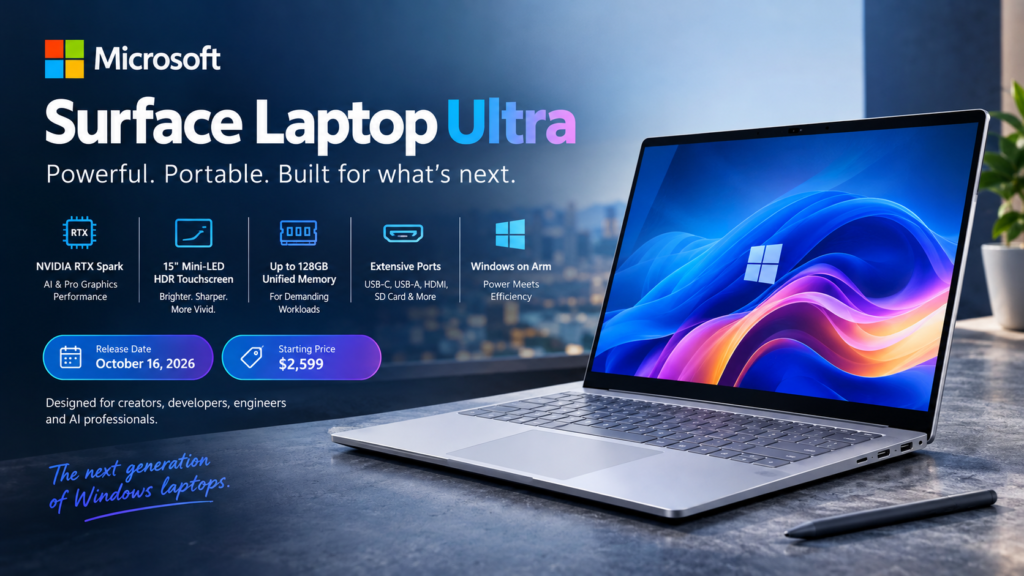
Microsoft is taking aim at the premium laptop market with the Surface Laptop Ultra, a powerful 15-inch Windows laptop designed for creators, developers, engineers, AI professionals, and users who need workstation-class performance in a portable computer.
Following its October 7 announcement, Microsoft confirmed the Surface Laptop Ultra price starts at $2,599, with the first models scheduled to launch on October 16, 2026. The machine is positioned directly against Apple’s high-end MacBook Pro, but Microsoft is taking a very different approach by combining Windows on Arm with NVIDIA’s new RTX Spark platform, large amounts of unified memory, a high-resolution mini-LED touchscreen, and extensive connectivity.
Microsoft Surface Laptop Ultra Release Date and Price
The Surface Laptop Ultra release date is October 16, 2026. Microsoft has opened preorders, giving professional users an opportunity to secure the new laptop before it reaches customers.
The starting price is $2,599, putting the Surface Laptop Ultra below the $2,999 starting price of Apple’s 16-inch MacBook Pro referenced by Microsoft and other reports. Higher configurations are aimed at professionals who need substantially more memory and processing capability, with top configurations reported at around $5,899.
Microsoft is also trying to make switching from Apple more attractive. Eligible MacBook owners can receive up to $1,000 in cash back when trading in a qualifying MacBook while purchasing a Surface Laptop Ultra. That promotion makes the effective cost significantly more competitive for professionals already invested in Apple’s laptop ecosystem.
RTX Spark Powers the Surface Laptop Ultra
The most important feature of the new Surface Laptop Ultra is arguably the hardware underneath its chassis.
Microsoft has partnered with NVIDIA around the new RTX Spark chip, an Arm-based platform combining an NVIDIA Blackwell RTX GPU with an NVIDIA Grace CPU. Depending on configuration, the platform can provide up to 20 CPU cores, up to 6,144 GPU cores, and up to 128GB of unified memory.
This architecture is particularly significant for local AI.
Instead of depending entirely on cloud-based services, users can run increasingly demanding artificial intelligence workloads directly on the laptop. This can benefit developers working with AI models, creators using generative applications, engineers running simulations, and professionals who want greater control over sensitive information.
Microsoft is positioning the machine for AI, software development, 3D workloads, engineering, and demanding creative applications, rather than treating it as simply another premium productivity laptop.
Surface Laptop Ultra Uses Windows on Arm
The RTX Spark architecture also introduces an important change for Windows users.
The Surface Laptop Ultra runs Windows on Arm, meaning applications designed specifically for Arm can run natively while traditional x86 Windows applications can use Microsoft’s Prism emulation technology.
This approach gives Microsoft a way to combine the efficiency of an Arm architecture with access to the enormous Windows software ecosystem.
For professional buyers, application compatibility will therefore remain an important consideration. Native Arm applications should provide the most optimized experience, while legacy x86 software depends on Microsoft’s compatibility layer.
As Windows continues moving toward heterogeneous computing and AI-focused PCs, the Surface Laptop Ultra represents a significant step toward making high-performance Arm-based Windows hardware more relevant to professional users.
15-Inch Mini-LED HDR Touchscreen
The display is another major selling point.
The 15-inch Surface Laptop Ultra uses a mini-LED display with HDR capabilities and touchscreen support. Microsoft describes it as the brightest, sharpest and most vivid display it has put into a Surface device.
Microsoft says the laptop’s peak HDR brightness is 25% higher than the M5 MacBook Pro’s. The display supports touch gestures and navigation, although it does not support pen input.
For photographers, video editors, designers and other visual professionals, mini-LED technology can provide stronger contrast, higher brightness and more effective HDR performance than conventional LCD panels.
The touchscreen also gives Windows users another interaction method, although professionals who specifically require active stylus support will need to consider that limitation.
Surface Laptop Ultra Design and Port Selection
Microsoft has designed the Surface Laptop Ultra around a premium aluminum-style form factor while keeping the device lighter than Apple’s 16-inch MacBook Pro.
One of the most interesting hardware additions is Magnetic Connect, Microsoft’s magnetic USB-C charging implementation. The company describes it as the world’s first built-in magnetic USB-C charging system on a laptop.
The connectivity selection is also unusually generous for a modern premium laptop.
The Surface Laptop Ultra includes:
- Three USB-C ports
- One USB-A port
- HDMI
- SD card reader
- 3.5mm headphone jack
- Magnetic USB-C charging
- Large haptic trackpad
For photographers and videographers, the integrated SD card reader can eliminate the need for an external adapter. The presence of USB-A and HDMI is equally useful for professionals who regularly connect older accessories, displays, projectors, storage devices and production equipment.
Upgradeable Storage and Professional Hardware
Another notable characteristic is upgradeable storage.
While many premium laptops increasingly integrate components directly onto the motherboard, Microsoft’s approach gives professional users more flexibility around storage capacity.
That could make the Surface Laptop Ultra particularly appealing to creators who work with large video projects, 3D assets, photography libraries, datasets and AI development environments.
The availability of configurations reaching 128GB of unified memory is especially important. AI applications can consume enormous amounts of memory, and unified memory allows the CPU and GPU to work within the same memory pool.
This makes the Surface Laptop Ultra fundamentally different from a conventional productivity notebook.
Surface Laptop Ultra for AI and Developers
The strongest reason to consider the Surface Laptop Ultra may be its focus on local AI computing.
Cloud AI has become extremely powerful, but running models locally can provide advantages involving responsiveness, privacy, offline operation and potentially lower recurring cloud-computing costs.
Microsoft’s broader Windows strategy is also moving toward hybrid AI, where local hardware and cloud infrastructure work together instead of forcing every workload into one environment. Microsoft’s October event focused heavily on local AI and the future of Windows computing.
For developers, this creates a more interesting proposition than a traditional high-end laptop. A sufficiently powerful local machine can become a development platform for AI applications rather than simply a device used to access cloud AI services.
Surface Laptop Ultra vs MacBook Pro
The most obvious competitor is the MacBook Pro.
Microsoft is deliberately targeting the same professional audience: developers, engineers, designers, content creators and other demanding users.
The Surface Laptop Ultra’s strategy differs from Apple’s approach in several ways.
Microsoft emphasizes Windows compatibility, touchscreen interaction, extensive physical connectivity, upgradeable storage and NVIDIA GPU technology. Apple emphasizes its custom silicon, macOS ecosystem, battery efficiency and integrated hardware-software experience.
The Surface Laptop Ultra also starts at $2,599, while Microsoft’s comparison places it below the $2,999 starting price of the 16-inch MacBook Pro.
The real competition, however, will not simply be decided by specifications. Professional buyers will ultimately care about application compatibility, sustained performance, thermals, battery life, driver support and how effectively the RTX Spark platform handles real-world AI and creative workloads.
Surface RTX Spark Dev Box
Microsoft introduced another RTX Spark product alongside the laptop: the Surface RTX Spark Dev Box.
Priced from $5,999, the desktop-oriented system is designed specifically for developers and advanced AI workloads. Microsoft says it can deliver up to 1 petaflop of AI performance and support AI models with up to 120 billion parameters.
This shows that Microsoft and NVIDIA are not treating RTX Spark simply as a laptop graphics platform. The broader goal is to establish a new class of local AI computers capable of handling workloads that traditionally required powerful workstations or cloud infrastructure.
Who Should Buy the Surface Laptop Ultra?
The Surface Laptop Ultra is clearly not designed for the average student or casual laptop user.
It makes the most sense for people who can take advantage of its high-end hardware.
Developers may benefit from the RTX Spark architecture and large unified memory capacity for AI and software development.
Video editors and creators can take advantage of the high-brightness HDR display, powerful GPU hardware, SD card reader and large memory configurations.
3D artists and engineers can benefit from the combination of CPU and Blackwell GPU capabilities.
AI professionals are perhaps the most obvious target because local model execution is central to the device’s design.
For ordinary web browsing, office work, streaming and basic productivity, the additional hardware may be difficult to justify.
Surface Laptop Ultra: What Makes It Different?
The Surface Laptop Ultra is important because it represents a broader change in the premium Windows laptop market.
Instead of competing solely on processor speed, Microsoft is building around local artificial intelligence, unified memory, GPU acceleration and professional workloads.
The RTX Spark platform brings technologies traditionally associated with workstations, AI systems and high-end graphics hardware into a laptop form factor. Combined with Windows on Arm, Microsoft’s approach could eventually create a new category of powerful mobile AI workstations.
The device also demonstrates that Microsoft is willing to compete directly with Apple’s premium MacBook Pro lineup rather than positioning Surface as a secondary alternative.
Final Verdict
The Microsoft Surface Laptop Ultra is shaping up to be one of the most ambitious Surface laptops yet.
With a 15-inch mini-LED HDR touchscreen, NVIDIA RTX Spark architecture, up to 128GB of unified memory, extensive connectivity, upgradeable storage and a starting price of $2,599, Microsoft is targeting users who demand considerably more than conventional laptop performance.
Its October 16, 2026 release date puts it directly into a rapidly evolving premium laptop market, where Apple is also expected to expand its MacBook Pro capabilities.
The biggest question will be real-world performance. Specifications alone cannot determine whether RTX Spark will become a serious alternative to Apple’s silicon for professional workloads. Application compatibility, Windows on Arm optimization, thermals, battery life and AI software support will ultimately determine how successful Microsoft’s new flagship becomes.
For users who want a high-performance Windows laptop built around local AI, however, the Surface Laptop Ultra is one of the most significant new options to watch in 2026.