
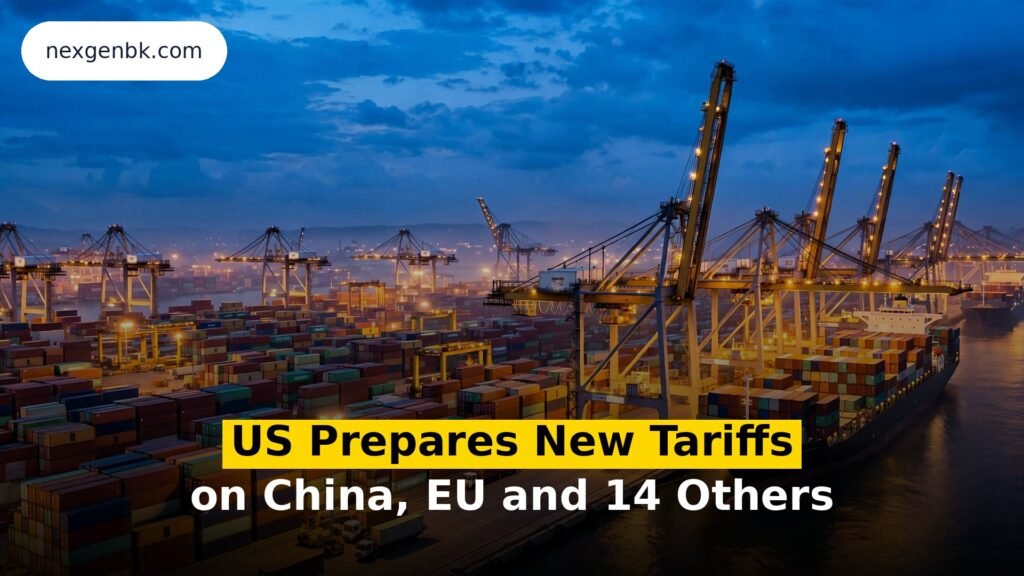
The United States is preparing a new round of tariffs that could reshape trade with China, the European Union and 14 other economies. US Trade Representative Jamieson Greer is expected to unveil findings of a months-long investigation into industrial subsidies and excess manufacturing capacity as soon as this week, according to the Wall Street Journal. Bloomberg has reported it could come as early as Tuesday 24 November 2026, though the timing could still change.
The move would replace the sweeping April 2025 duties that the Supreme Court struck down earlier this year. Unlike those duties, which rested on emergency powers, the new tariffs would rest on Section 301 of the Trade Act of 1974 — and be tailored economy by economy.
The investigation covers 16 economies, from China and the EU to Japan, South Korea, India, Vietnam, Mexico and Taiwan, and most products would be covered. Yet the final tariff rates, the full product range and the effective date have not yet been set. This article sets out what is confirmed and what is still undecided.
Key facts
- The announcement: Jamieson Greer is expected to unveil findings of a Section 301 industrial-subsidies and excess-capacity investigation as soon as this week; Bloomberg reported as early as Tuesday 24 November 2026
- The scope: China, the EU and 14 other economies, per the Wall Street Journal — the March 2026 probe covered 16 economies in total
- The legal basis: Section 301, replacing the April 2025 duties struck down by the Supreme Court in February 2026
- The rates: tailored per economy, within negotiated deal caps — the EU, Japan and South Korea around 15% or lower, China not above 20%, India and Vietnam possibly higher
- Exclusions: steel, aluminium and autos excluded — separate national-security tariffs already apply
- Not yet set: final rates, product range and effective date have not been decided, per Bloomberg
- The investigation: launched 11 March 2026; comment period closed 15 April 2026; hearing held around 5 May 2026
What the USTR is about to announce
Greer launched the probe on 11 March 2026; the Federal Register filing set out its scope and invited public comment, which closed on 15 April 2026, and a public hearing was held around 5 May 2026. The findings now expected would formally determine that the practices under investigation are unreasonable or discriminatory and burden American commerce — the finding Section 301 requires before tariffs can be imposed.
The Wall Street Journal reported on 24 November 2026 that Greer was expected to unveil the findings as soon as this week; Bloomberg reported the announcement could come as early as Tuesday 24 November. Neither has confirmed the schedule: the USTR declined to comment, and the White House did not respond. The announcement will not itself be the final word: the final rates, product coverage and effective date have not yet been set, according to Bloomberg.
The 16 economies in the probe
The Wall Street Journal describes the coming tariffs as covering China, the European Union and 14 other economies. The probe as launched in March 2026 covered 16 economies in total: China, the European Union, Singapore, Switzerland, Norway, Indonesia, Malaysia, Cambodia, Thailand, South Korea, Vietnam, Taiwan, Bangladesh, Mexico, Japan and India. The two descriptions are consistent — China and the EU plus 14 others make 16.
The list spans the world’s major manufacturing centres: the largest exporters to the United States, the biggest industrial economies in Asia, and several countries that absorbed manufacturing as companies diversified away from China. It includes close American allies — Japan, South Korea and the EU members — alongside economies with which the United States has a far more adversarial relationship. It should not be confused with a separate Section 301 probe on forced-labour import prohibitions, covering 59 countries plus the EU. That is a different inquiry; the tariffs expected this week arise from the excess-capacity investigation alone.
Why now: the Supreme Court ruling and the 10% surcharge
In April 2025 the administration imposed sweeping duties on imports from around the world. Those duties were challenged in court, and in February 2026 the Supreme Court struck them down in Learning Resources, Inc. v. Trump, ruling that the International Emergency Economic Powers Act — the statute the administration had relied on — does not authorise tariffs.
The ruling removed the legal foundation of the April 2025 duties at a stroke. In response, the administration imposed a 10 percent global import surcharge under Section 122, effective 24 February 2026 — a temporary stopgap. Section 301 is the lasting answer the administration has chosen: a well-established statute used by administrations of both parties, it authorises the USTR to investigate foreign practices burdening American commerce and impose tariffs in response. It is slower, but far harder to challenge in court, and the investigation was launched on 11 March 2026, within weeks of the ruling.
What the tariffs could look like
The clearest reporting so far concerns the shape of the rates, not their exact levels. The tariffs are expected to be tailored to each economy, rather than applied at a single uniform rate, and generally to sit within caps already agreed in trade deals negotiated over the past year. For the European Union, Japan and South Korea, that means rates of around 15 percent or lower — the EU’s rate below the 15 percent threshold agreed with European Commission president Ursula von der Leyen in Scotland.
China is expected to face a rate not above 20 percent, far below the much higher rates imposed on Chinese goods in April 2025 — suggesting the administration is keeping the new duties within bounds already discussed with Beijing rather than returning to last year’s escalation. India and Vietnam, by contrast, could face higher rates, depending on the agreements they have reached with Washington; the reporting puts no number on those rates. Exemptions are expected, and rates could be reduced later if countries curb their excess production.
What is covered — and what is not
Most products are expected to be covered. The sectors named in the USTR’s filing include aluminium, automobiles, batteries, electronics, machinery, paper, plastics, robotics, satellites, semiconductors, ships, solar modules and steel.
There are, however, three notable exclusions. Steel, aluminium and autos are expected to be left out, because separate national-security tariffs already apply to them, and layering a second set of duties on top would be both redundant and legally complicated. The exclusion does not mean those sectors escape tariffs — they are already subject to them under a different authority. The breadth of coverage is one reason the announcement matters: a tariff covering most products across 16 economies affects almost every importer, and almost every consumer, in the United States. Until the final product list appears, companies must plan around the outlines — the economies, the likely rate bands and the three exclusions — without knowing precisely which products will be caught, at what rate, and from when.
The excess-capacity argument
At the heart of the investigation is a single argument: that the economies under investigation have built manufacturing capacity far beyond what their own markets, or global demand, can absorb. The USTR alleges that this excess capacity is “untethered from the incentives of domestic and global demand” — driven by government policy and subsidy rather than by customer demand. The consequence, in the USTR’s account, is a flood of cheap goods onto world markets.
The investigation singles out particular economies for particular reasons. China is singled out for a trade surplus across a wide range of sectors — the breadth of the surplus, rather than its size in any one industry, is the evidence. The European Union is singled out with particular attention to Germany and Ireland, and to chemicals, machinery and vehicles. Taiwan is singled out over semiconductors and electronics, in which it dominates global supply. These are allegations, not a verdict: the findings expected this week will be the USTR’s formal statement of its case, and they will be debated as soon as they are published.
“The investigation alleges that excess manufacturing capacity in the economies under review is ‘untethered from the incentives of domestic and global demand’ — driven by industrial policy and subsidy rather than by customer demand.”
— US Trade Representative, Section 301 investigation filing, March 2026
What it means for businesses and consumers
For American businesses importing from the 16 economies, the tariffs would mean higher costs on most of what they buy. Importers pay tariffs, and typically pass at least part of the cost onward — to the companies that buy their goods, and ultimately to consumers. A rate of 15 percent on EU or Japanese goods, or up to 20 percent on Chinese goods, would materially raise the cost of doing business for any company with supply chains in those economies. The impact would not fall evenly: companies depending heavily on a single country on the list — Vietnam for clothing and electronics, or Taiwan for semiconductors — would face a sharper adjustment.
Consumers would feel the effects more slowly, and less visibly. Tariffs do not appear on a receipt; they show up as higher prices, reduced choice, or products quietly disappearing from shelves. The 10 percent surcharge in place since February has already begun this work, and the new duties would add to it. Tariffs also change where goods are made: duties on 16 economies at once give companies a reason to seek suppliers outside the list, or to bring production home. But shifting a supply chain takes months or years, and meanwhile the cost falls on businesses and consumers with no alternative.
What happens next
The immediate next step is the announcement itself. When Greer unveils the findings, the world will learn the USTR’s formal determination and, most likely, the framework for the tariffs to follow. The final rates, product list and effective date are expected to come later. Negotiation is likely to continue in parallel: rates could reportedly be reduced if countries curb their excess production, so economies on the list will have an incentive to offer concessions for lower rates or broader exemptions.
Retaliation is also a possibility. The economies on the list include some of the United States’ largest trading partners, and several have retaliated against American tariffs in the past. Whether they do, and how far they go, will depend on the final rates. For now, the confirmed position is this: an announcement is expected as soon as this week, covering China, the EU and 14 other economies, under Section 301, with rates tailored per economy and most products covered. The final numbers are not set, the effective date is not set, and the USTR has declined to comment.
Frequently asked questions
What tariffs is the US preparing, and who do they cover?
The United States is preparing new Section 301 tariffs targeting industrial subsidies and excess manufacturing capacity. They are expected to cover China, the EU and 14 other economies — 16 in total, including Japan, South Korea, India, Vietnam, Taiwan, Mexico, Singapore, Switzerland, Norway, Indonesia, Malaysia, Cambodia, Thailand and Bangladesh.
When will the new tariffs be announced?
Greer is expected to unveil the findings as soon as this week. Bloomberg reported the announcement could come as early as Tuesday 24 November 2026, but the timing could change; neither the USTR nor the White House has confirmed a date.
How high will the new tariff rates be?
No final rates have been set. Rates will reportedly be tailored per economy and generally kept within negotiated deal caps: the EU, Japan and South Korea at around 15 percent or lower, China not above 20 percent, and India and Vietnam possibly higher depending on their agreements. Exemptions are expected, and rates could be reduced if countries curb excess production.
Why is the US using Section 301 this time?
The April 2025 duties were struck down by the Supreme Court in February 2026 in Learning Resources, Inc. v. Trump, which ruled that the International Emergency Economic Powers Act does not authorise tariffs. Section 301 is a dedicated trade statute authorising tariffs after an investigation, a public comment period and a hearing — all of which have taken place. A temporary 10 percent global surcharge under Section 122 has been in effect since 24 February 2026.
Are steel, aluminium and cars covered by the new tariffs?
No. Steel, aluminium and autos are expected to be excluded because separate national-security tariffs already apply to them. Most other products are expected to be covered, although the final product list has not yet been published.