
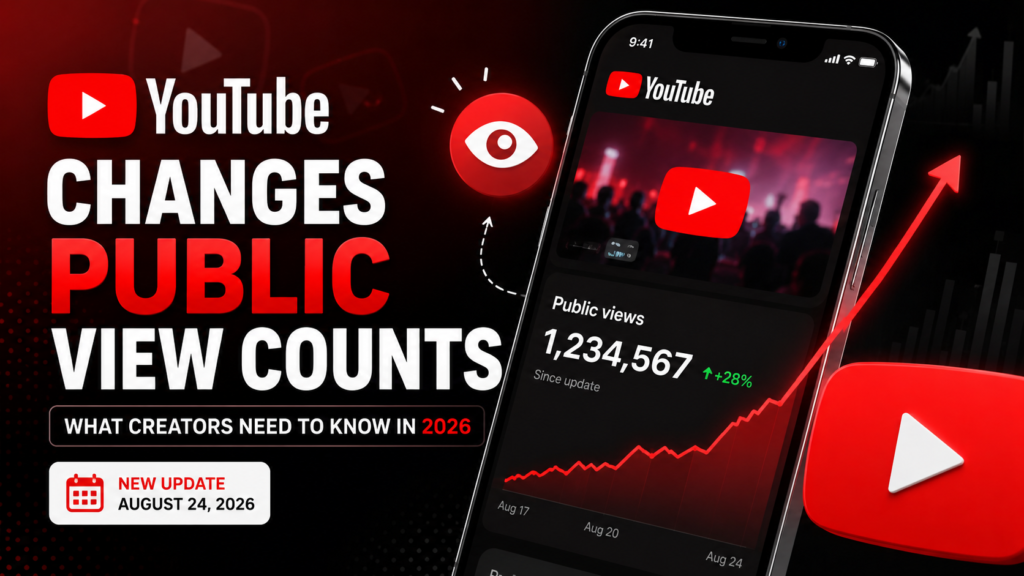
YouTube is changing the way it counts public video views, bringing its view-counting system closer to platforms such as TikTok and Instagram. Starting August 24, 2026, a public view can be counted as soon as a video begins playing.
The change could make view counts rise faster for many creators, but there is an important distinction: the new public view count does not mean creators will automatically earn more money.
What Is Changing on YouTube?
Previously, YouTube’s public view-counting system used a more restrictive methodology for determining when a view should be registered. Under the new system, a public view is counted when playback begins.
The change applies across YouTube’s video formats, including long-form videos, podcasts and livestreams.
This means a viewer does not necessarily need to watch a video for a longer period before that interaction contributes to the publicly displayed view number.
The result could be noticeably higher public view counts, particularly for videos that attract many viewers who leave shortly after playback starts.
Why Is YouTube Making This Change?
YouTube says the goal is to create greater consistency in how views are measured across the platform and better capture moments of connection between creators and audiences.
The move also brings YouTube’s public-facing metric closer to the way short-form platforms such as TikTok and Instagram Reels count views.
For creators competing across multiple platforms, this could make public view numbers easier to compare at a basic level.
However, the underlying measurement of viewer engagement remains much more complicated than the number displayed beneath a video.
Your View Count May Increase — But Your Earnings Won’t Automatically Increase
This is probably the most important part of the update.
A higher public view count does not mean YouTube is paying creators for every newly counted public view.
YouTube continues to use separate measurement systems for advertising and creator analytics. YouTube’s own documentation distinguishes views from other engagement metrics, while its advertising-related view methodology can differ from the public counter.
In other words, creators should not assume that a sudden increase in public views will result in a proportional increase in revenue.
For example, if a video previously showed 100,000 public views and the new methodology causes it to display 130,000, that does not mean the creator will suddenly receive 30% more advertising revenue.
What Happens to the Old Engagement Data?
The change does not make meaningful engagement metrics irrelevant.
YouTube Analytics still provides creators with information such as:
- Watch time
- Average view duration
- Audience retention
- Traffic sources
- Audience information
- Engagement data
- Advanced performance reports
YouTube recommends using YouTube Studio Analytics to analyze channel and video performance rather than relying on a single metric.
This is particularly important after the public view-counting change.
A video with 1 million views is not necessarily more successful than another video with 500,000 views if viewers of the second video watch significantly more of the content.
Why Watch Time and Retention Still Matter
Imagine two videos:
Video A
- 1 million public views
- Average viewer watches 10 seconds
Video B
- 600,000 public views
- Average viewer watches 5 minutes
Looking only at the public view count, Video A appears to be the bigger success.
But Video B may have a much stronger audience relationship because viewers are spending substantially more time watching it.
That is why creators should continue paying close attention to audience retention, average view duration and watch time instead of treating the public view number as the complete picture of performance.
What Does This Mean for YouTube Creators?
For creators, the change can have several practical effects.
1. Public View Counts Could Rise Faster
Because views can be registered from the beginning of playback, creators may see higher numbers than they would have under the previous methodology.
This could be especially noticeable for videos with high click-through rates but relatively low retention.
2. View Counts May Become Less Comparable With Older Videos
Creators should be careful when comparing videos published before and after the change.
A video uploaded under the previous counting methodology and a video uploaded after August 24 may not represent exactly the same type of public-view measurement.
That means historical comparisons could become more complicated.
3. Engagement Becomes Even More Important
As public views become easier to generate, metrics that show whether viewers actually stayed become more valuable.
Creators should monitor:
- Audience retention
- Average view duration
- Watch time
- Likes and comments
- Subscribers gained
- Returning viewers
- Click-through rate
These metrics can provide a much clearer picture of whether a video is genuinely connecting with its audience.
What About YouTube Monetization?
The public view-counting update should not be confused with YouTube Partner Program monetization requirements.
YouTube’s monetization system continues to distinguish between different types of eligible views and watch hours. For example, YouTube’s YPP documentation specifies requirements involving valid public watch hours and valid public Shorts views.
Therefore, creators should not assume that the new public counter changes their eligibility for monetization.
Likewise, a higher public view number should not automatically be interpreted as higher advertising revenue.
What Does This Mean for Advertisers?
The change could also create new challenges for advertisers.
Brands often use video views as a basic indicator of reach, but different platforms have historically used different definitions of what constitutes a view.
YouTube’s change brings its public metric closer to platforms that register views quickly, while advertising measurement can continue to use different standards.
This means advertisers may need to look beyond headline view counts when comparing campaigns across YouTube, TikTok, Instagram and other platforms.
Metrics such as watch time, completion rate, audience quality and conversions can provide more useful information about campaign performance.
YouTube Is Moving Toward a More Short-Form-Friendly Measurement System
The change reflects a broader transformation in online video.
TikTok, Instagram Reels and YouTube Shorts have popularized extremely fast consumption patterns. A viewer can swipe through several videos within seconds.
YouTube is increasingly competing in this environment while still supporting long-form videos, podcasts, livestreams and traditional creator content.
Updating the public view counter may therefore be part of a larger effort to create a more consistent measurement experience across different types of content.
Should Creators Change Their Content Strategy?
There is no reason to completely redesign your YouTube strategy simply because the public view counter has changed.
Instead, creators should focus on producing content that encourages viewers to stay longer and return to the channel.
A strong strategy includes:
Create a strong opening: The first few seconds should immediately communicate why viewers should continue watching.
Improve thumbnails and titles: Getting a click is important, but the content needs to deliver what the title and thumbnail promise.
Monitor retention: Identify exactly where viewers leave and improve those sections in future videos.
Study returning viewers: Loyal audiences are often more valuable than one-time clicks.
Use YouTube Analytics: Compare videos using multiple performance indicators rather than public views alone.
The Bigger Picture
YouTube’s new view-counting system may make public numbers look more impressive, but the real measure of a successful channel remains much deeper.
A view is only the beginning of the relationship between a creator and a viewer.
The more important questions are:
Did the viewer stay?
Did they enjoy the content?
Did they watch another video?
Did they subscribe?
Did they return later?
Those signals can tell creators much more about the health of their channels than a single number beneath a video.
Summary
YouTube’s public view-counting change is an important update for creators, marketers and advertisers. From August 24, 2026, public views can be counted from the moment playback begins, potentially making view numbers increase faster and aligning YouTube more closely with other major video platforms.
However, more public views do not automatically mean more revenue or stronger audience engagement.
Creators should continue focusing on watch time, retention, audience satisfaction and returning viewers. YouTube Studio provides the detailed analytics needed to understand those deeper performance signals.
Ultimately, the number of views may tell you how many times a video started playing. The quality of those views tells you whether your content is actually working.