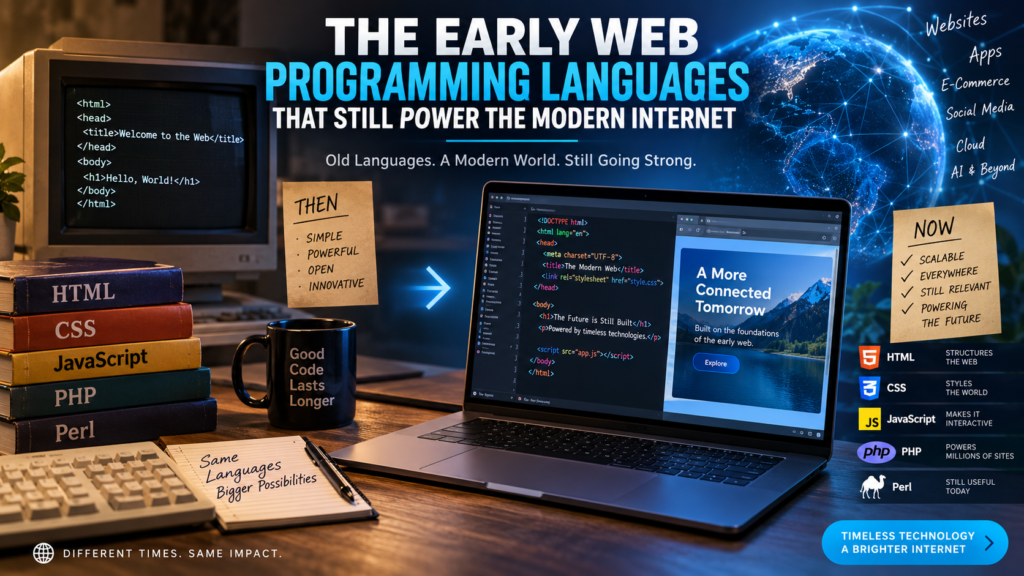
The internet may look completely different from the web of the 1990s, but some of its most important technologies are surprisingly old.
Modern websites now rely on cloud computing, artificial intelligence, APIs, responsive interfaces, edge networks, and sophisticated JavaScript frameworks. Yet underneath many of these technologies are web standards and programming languages that have been around for decades.
HTML, CSS, PHP, Perl, and Erlang all emerged during the formative years of the internet. Some are not technically programming languages—HTML is a markup language and CSS is a style-sheet language—but all five played important roles in shaping how the web works.
So why have these technologies survived while countless others disappeared?
The answer is simple: they solved fundamental problems, developed with the web, and became deeply embedded in the infrastructure developers still use today.
1. HTML: The Foundation of Every Web Page
HTML, or HyperText Markup Language, is one of the most important technologies in the history of the World Wide Web.
It defines the structure and meaning of content on a webpage. Headings, paragraphs, images, links, forms, tables, articles, and many other elements are represented through HTML.
Although modern websites can contain sophisticated applications and interactive interfaces, the underlying document structure is still built around HTML.
HTML’s roots go back to Tim Berners-Lee’s work at CERN in the early 1990s. The technology became fundamental to the web because browsers could interpret HTML documents and present them as webpages.
Why HTML still matters
HTML remains essential because it provides the basic structure that browsers understand.
It also plays an important role in:
- Search engine optimization
- Website accessibility
- Responsive web design
- Content organization
- Browser compatibility
- Web application interfaces
Modern HTML has evolved significantly compared with the early web. Today’s standard supports multimedia, semantic elements, forms, graphics, and many other capabilities.
In other words, HTML did not disappear because the web became more advanced. It evolved alongside it.
2. CSS: The Technology That Made the Web Beautiful
Early websites were extremely basic. Pages were primarily collections of text and links, with very limited control over layout and presentation.
CSS—Cascading Style Sheets—changed that.
Introduced in the 1990s, CSS separated the structure of a webpage from its visual presentation. Instead of putting styling information throughout HTML, developers could create style rules that controlled colors, typography, spacing, layouts, and other visual characteristics.
Today, CSS is responsible for much more than changing text colors.
Modern CSS supports:
- Responsive layouts
- Flexbox
- CSS Grid
- Animations
- Transitions
- Custom properties
- Advanced typography
- Mobile-first design
- Complex visual interfaces
CSS is also one of the core technologies recommended for WordPress development alongside HTML, PHP, and JavaScript.
Why CSS survived
CSS became deeply integrated into the web because developers needed a standardized way to control how content looked across different devices and browsers.
Its continued development has allowed it to remain useful even as websites moved from desktop monitors to smartphones, tablets, smart TVs, and other connected devices.
3. PHP: The Language Behind Millions of Websites
PHP is one of the most influential server-side technologies in web development.
Originally created by Rasmus Lerdorf in the 1990s, PHP evolved from a collection of tools into a general-purpose server-side scripting language.
Its major advantage was its ability to generate dynamic webpages.
Instead of delivering exactly the same static HTML file to every visitor, a server could use PHP to process information and generate content dynamically.
That capability helped fuel the growth of interactive websites, content management systems, forums, ecommerce platforms, and other web applications.
PHP and WordPress
One of PHP’s biggest modern connections is WordPress.
WordPress uses PHP extensively, making PHP knowledge particularly valuable for developers who build custom themes, plugins, integrations, and backend functionality.
WordPress itself identifies HTML, CSS, PHP, and JavaScript as key technologies developers work with when building themes and plugins.
PHP is also associated with major websites and platforms, including Wikipedia and other content-driven services.
Is PHP still relevant in 2026?
Absolutely.
PHP may not receive the same level of attention as newer programming languages, but its enormous installed base makes it difficult to replace.
Millions of websites depend on PHP-based systems, and businesses continue to maintain and modernize applications built with it.
For anyone interested in WordPress development, freelance website development, or maintaining existing web applications, PHP remains a practical skill.
4. Perl: An Early Web Scripting Workhorse
Perl is considerably older than the World Wide Web itself.
Created by Larry Wall and first released in 1987, Perl became extremely popular for text processing, system administration, automation, and scripting.
During the early growth of the web, Perl became closely associated with CGI, or Common Gateway Interface.
CGI allowed web servers to execute scripts and dynamically generate responses for visitors. That made it possible to move beyond static HTML pages and build interactive web experiences.
Perl became an important part of the early dynamic web and was once described as the “duct tape” of the internet.
Why Perl still has historical importance
Perl’s influence extends beyond the websites that used it directly.
It helped demonstrate how server-side scripting could make websites interactive and dynamic.
Some well-known internet services also have historical connections to Perl. For example, DuckDuckGo has discussed its use of Perl-based technology, while the IMDb website also had a long history with Perl.
Perl is no longer the default choice for most new web applications, but its legacy remains visible throughout internet infrastructure and software development.
5. Erlang: The Old Language Behind Modern-Scale Messaging
Erlang is perhaps the least familiar name on this list, but it has an impressive history.
Developed at Ericsson during the 1980s, Erlang was originally designed for telecommunications systems where reliability, concurrency, and communication between processes were critical.
Those characteristics turned out to be extremely useful for internet applications.
Erlang’s BEAM virtual machine allows applications to handle large numbers of concurrent processes and messages. This makes it particularly well suited to systems where many users or services need to communicate simultaneously.
Erlang and modern communication platforms
Erlang has been associated with major communication services, including WhatsApp and Discord, while the Elixir programming language builds on the BEAM ecosystem.
The language’s history demonstrates an important lesson in software engineering:
A technology does not need to be trendy to remain useful.
Erlang’s strengths in concurrency, fault tolerance, and distributed systems can still be extremely valuable for modern internet applications.
Why Do These Old Technologies Still Matter?
The survival of these technologies isn’t simply an accident.
They share several characteristics that helped them remain relevant.
1. They became standards
HTML and CSS became fundamental web technologies. Once millions of websites, browsers, developers, and organizations depended on them, replacing them became impractical.
2. They evolved
These technologies did not remain frozen in their original forms.
HTML and CSS have developed significantly over the decades, while PHP has gone through major changes and modernization.
3. Huge ecosystems were built around them
PHP’s relationship with WordPress is a perfect example.
Once an ecosystem becomes large enough, the technology behind it can remain commercially important for decades.
4. They solve fundamental problems
HTML structures information.
CSS controls presentation.
PHP processes server-side web requests.
Perl provides scripting and automation capabilities.
Erlang handles concurrency and distributed communication.
These are fundamental requirements that modern websites still need.
Old Technologies vs. Modern Web Development
It is tempting to assume that newer programming languages automatically replace older ones.
The reality is more complicated.
Modern web development frequently combines multiple technologies rather than relying on a single programming language.
A website might use:
| Technology | Typical Role |
|---|---|
| HTML | Page structure |
| CSS | Design and layout |
| JavaScript | Interactivity |
| PHP | Server-side functionality |
| Python | Backend, automation and AI |
| SQL | Database operations |
| TypeScript | Large-scale JavaScript development |
| Erlang/Elixir | Concurrent and distributed systems |
Modern developers therefore don’t necessarily choose between “old” and “new.” They often combine technologies according to the requirements of a particular project.
What Should Beginners Learn Today?
If you’re learning web development in 2026, understanding the fundamentals is still one of the smartest approaches.
A practical learning path is:
HTML → CSS → JavaScript → Git → Backend technology → Databases → Frameworks
HTML and CSS give beginners a foundation for understanding how websites are structured and presented. JavaScript then introduces programming and interaction.
After that, developers can choose a backend technology such as PHP, Python, JavaScript/Node.js, Java, C#, or another language depending on their career goals.
Current web-development guides continue to place HTML/CSS and JavaScript/TypeScript at the center of modern web development, while PHP remains a practical choice for WordPress-based projects.
The Bigger Lesson From the Early Web
The history of web development offers an important lesson: technology does not have to be new to be valuable.
HTML and CSS remain fundamental standards.
PHP continues to power a huge ecosystem of websites.
Perl remains an important part of programming history and legacy infrastructure.
Erlang continues to demonstrate the value of concurrency and fault tolerance in internet-scale systems.
Meanwhile, newer technologies such as TypeScript, Python, cloud platforms, AI tools, and modern frameworks are building on top of an internet that still depends heavily on its older foundations.
The modern web isn’t a complete replacement for the old web.
It is the old web—continuously upgraded.
Frequently Asked Questions
What are the oldest programming languages still used on the web?
Several older technologies remain relevant, including HTML, CSS, PHP, Perl, and Erlang. Their roles differ, and HTML and CSS are technically markup/style languages rather than traditional programming languages.
Is PHP still used for web development?
Yes. PHP remains particularly important because of its large ecosystem and its role in platforms such as WordPress.
Is HTML still important in 2026?
Yes. HTML remains the fundamental markup technology used to structure content for the web.
Is CSS still used for modern websites?
Yes. CSS remains essential for layout, responsive design, typography, animation, and visual presentation.
Should beginners learn old programming languages?
Beginners should focus on technologies that match their goals. HTML, CSS, and JavaScript are strong foundations for web development, while PHP can be especially useful for WordPress and certain backend careers.
Why is Erlang still used?
Erlang was designed around concurrency, reliability, and distributed communication. Those characteristics remain useful for systems that need to process large numbers of simultaneous messages and connections.
Final Thoughts
The internet changes incredibly quickly, but its foundations change much more slowly.
The technologies that helped build the early web solved fundamental problems, and many of those problems still exist today. That’s why HTML, CSS, PHP, Perl, and Erlang have survived multiple generations of web development.
For developers, the lesson is clear: learning the fundamentals can be more valuable than chasing every new trend.
The modern internet may look futuristic, but much of it is still standing on technology created decades ago.