
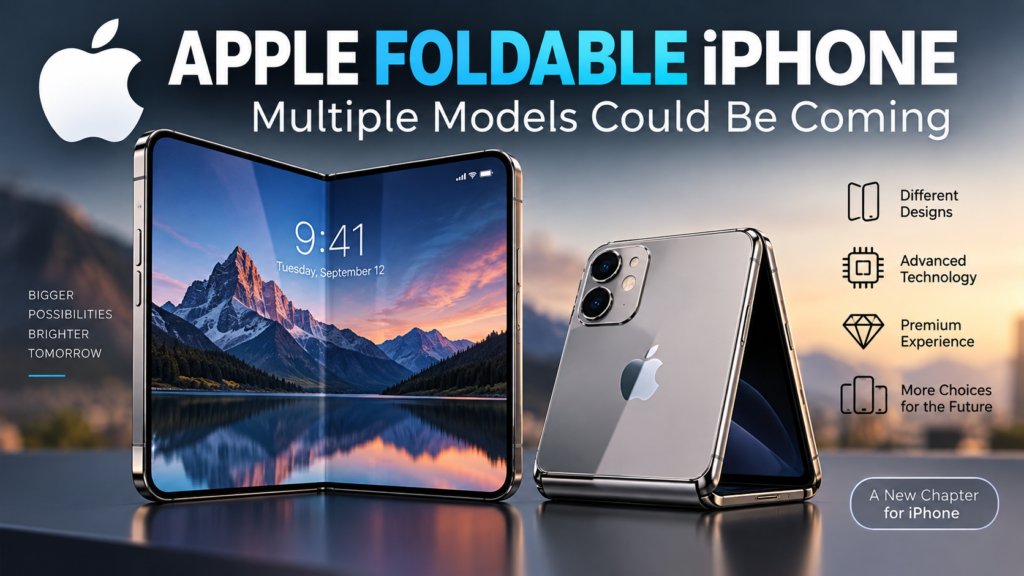
Apple may be preparing to make a major change to its iPhone lineup, with reports suggesting the company could eventually develop more than one foldable iPhone model.
Foldable smartphones have been available from competing manufacturers for years, but Apple has remained cautious about entering the category. That could soon change. Recent reports point toward Apple exploring multiple foldable designs rather than treating the technology as a one-off experiment.
If Apple does move forward with several foldable iPhones, the strategy could give consumers more choices while helping the company compete directly in the growing premium foldable-phone market.
Apple’s Foldable iPhone Plans Are Getting More Interesting
Apple has not publicly confirmed a complete foldable iPhone roadmap. However, reports and supply-chain rumors have increasingly pointed toward the company’s development of a foldable device.
Current Apple product reporting suggests that a first-generation foldable iPhone, sometimes referred to in reports as the iPhone Fold or iPhone Duo, is being positioned as a premium product. MacRumors currently lists the iPhone Duo among Apple’s upcoming products and reports that Apple’s first foldable iPhone is expected to arrive around the iPhone 18 Pro generation.
The possibility of multiple foldable devices makes the story even more significant.
Rather than launching one model and waiting to see how consumers respond, Apple could eventually build an entire foldable product category around different screen sizes, designs and price points.
Why Would Apple Build Multiple Foldable Phones?
The smartphone market is no longer dominated solely by traditional slab-style phones. Foldable devices offer manufacturers another way to differentiate their products.
A foldable iPhone could provide users with a compact device that transforms into a larger display when opened. This could be particularly useful for multitasking, gaming, video editing, reading and productivity.
Multiple models would allow Apple to target different types of customers.
For example, one foldable could focus on a traditional smartphone experience that opens into a larger tablet-like screen. Another could potentially use a smaller clamshell-style design aimed at portability and fashion-conscious consumers.
Apple could therefore use the same basic technology across several products while creating different experiences for different audiences.
A Premium Foldable iPhone Could Come First
The first Apple foldable is widely expected to sit at the premium end of the iPhone lineup.
That would make sense for Apple because foldable displays, specialized hinges and compact internal components can increase manufacturing costs. A premium launch would also allow Apple to introduce the technology without immediately trying to compete with lower-priced foldable phones.
Apple has historically used its premium products to introduce major hardware technologies before those technologies become more widely available.
The first foldable iPhone could therefore be positioned as an ultra-premium device rather than a replacement for the standard iPhone.
What Could the Design Look Like?
Apple has not confirmed the final design, but industry reports have generally focused on a book-style foldable concept.
This type of device works similarly to a small tablet that folds in half. When closed, it behaves like a conventional smartphone. When opened, the internal display provides a much larger workspace.
A successful Apple foldable would need to solve several problems that have affected early foldable phones, including:
- Display durability
- Hinge reliability
- Screen crease visibility
- Battery capacity
- Device thickness
- Weight
- Dust and water resistance
- Software optimization
Apple’s approach could be especially interesting because the company controls both the hardware and software experience.
Software Could Be One of Apple’s Biggest Advantages
Hardware alone will not determine whether a foldable iPhone succeeds.
The software experience could be just as important.
Apple could optimize iOS specifically for a flexible display, allowing apps to automatically adapt when the phone is opened. Multitasking could also become more powerful, potentially allowing users to work with multiple apps or larger content areas.
Apple’s current software direction already places significant emphasis on multitasking, Apple Intelligence and adaptive interfaces. The company could build on these technologies to make a foldable iPhone feel different from a standard iPhone rather than simply making the screen bigger.
The latest iOS generation also demonstrates Apple’s continued focus on AI-powered features and adaptive experiences, suggesting that software could play an important role in differentiating future hardware.
Could Apple Launch Different Foldable Form Factors?
This is one of the most interesting possibilities.
A book-style foldable may be the most obvious starting point, but Apple could eventually explore other form factors.
A clamshell-style iPhone could fold vertically and become significantly smaller when closed. Such a design could appeal to users who want a compact phone without giving up a large screen when needed.
Apple could also potentially develop larger foldable products positioned between an iPhone and an iPad.
However, these possibilities remain speculative. Apple has not announced a multi-model foldable lineup.
Apple Will Face Strong Competition
Apple would enter a market that already includes several established foldable smartphone manufacturers.
Companies such as Samsung, Google and other Android manufacturers have had years to refine foldable hardware.
Samsung, in particular, has established multiple foldable product categories, giving it experience with different screen formats, hinge mechanisms and software features.
That means Apple will not simply be competing on the novelty of having a foldable phone.
The company will need to convince consumers that its foldable offers meaningful advantages in design, durability, software and everyday usability.
Price Could Be a Major Challenge
The biggest barrier for many potential buyers could be price.
Premium foldable smartphones generally cost more than conventional flagship phones because of their specialized displays and mechanical components.
Apple’s reputation for premium pricing means a first-generation foldable iPhone could potentially be considerably more expensive than a standard iPhone.
That could make the product attractive primarily to enthusiasts, professionals and customers willing to pay for new technology.
If Apple eventually releases several foldable models, however, the company could create a broader pricing structure that makes the technology accessible to more consumers.
What Multiple Foldable iPhones Could Mean for the iPhone Lineup
If Apple eventually introduces multiple foldable models, the iPhone family could become much more diverse.
Consumers could potentially choose between:
- Traditional iPhone designs
- Larger premium iPhones
- Compact foldable devices
- Book-style foldable iPhones
- Larger foldable devices designed for productivity
This would represent a significant change from Apple’s historically straightforward iPhone lineup.
It could also allow Apple to experiment with new form factors without immediately replacing its conventional smartphones.
Apple Needs to Get the First Foldable Right
Apple’s delayed entry into the foldable market could actually become an advantage.
Instead of being an early adopter, Apple has had the opportunity to watch competitors identify the strengths and weaknesses of foldable smartphones.
The company can study issues such as display durability, hinge reliability, battery life, software compatibility and consumer demand before committing to a major launch.
That could help Apple avoid some of the problems encountered by earlier foldable devices.
The challenge will be meeting the high expectations associated with the iPhone brand.
When Could We See Apple’s Foldable iPhone?
Current reporting points toward a first foldable iPhone arriving around the iPhone 18 Pro generation, although Apple’s plans can change before an official announcement. MacRumors currently lists the iPhone Duo among Apple’s upcoming products.
It is important to distinguish between reported timelines and official information. Apple has not publicly confirmed every specification, name or launch detail associated with its rumored foldable products.
Final Thoughts
Apple’s possible move into foldable smartphones could become one of the biggest changes to the iPhone lineup in years.
The most interesting part may not simply be the arrival of Apple’s first foldable phone, but the possibility that the company could eventually develop multiple foldable models.
If Apple can combine a durable folding display with powerful hardware, optimized software and the familiar iPhone ecosystem, foldable technology could become an important part of the company’s future.
For now, consumers should treat specific specifications, pricing and additional model rumors as unconfirmed until Apple makes an official announcement. But if the current reports prove accurate, Apple’s entry into the foldable market could significantly increase competition in one of the smartphone industry’s most rapidly developing categories.