
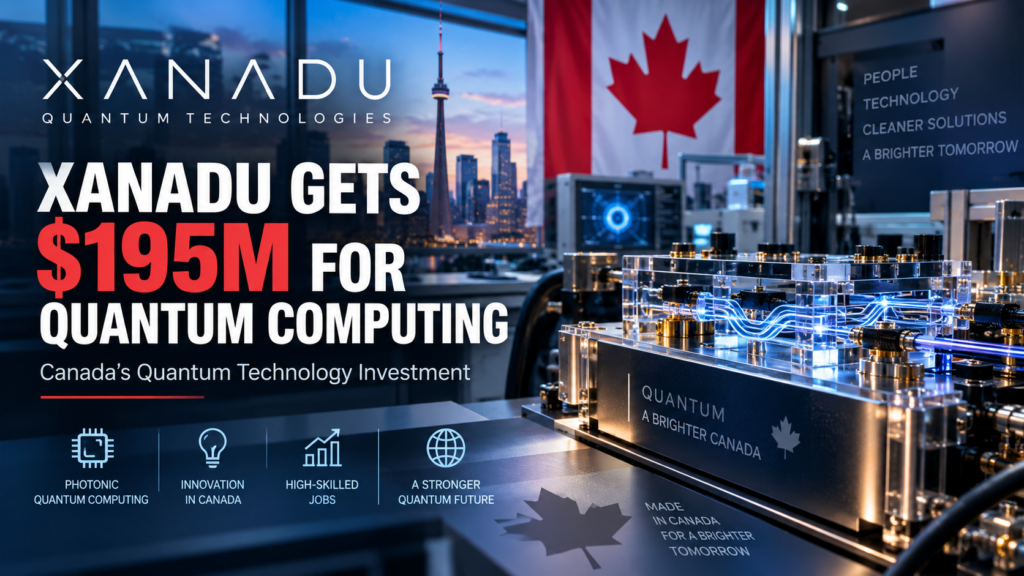
Canada is making a major investment in the future of quantum computing.
Xanadu Quantum Technologies has secured CAD $195 million in federal funding from the Government of Canada to expand its research, development and advanced manufacturing capabilities for photonic quantum computing.
The investment is part of Project OPTIMISM, an approximately CAD $893 million project designed to help establish the infrastructure needed to manufacture components for next-generation, fault-tolerant quantum computers in Canada.
The announcement represents one of Canada’s biggest steps yet toward building a domestic quantum technology supply chain.
What Is Xanadu’s $195 Million Quantum Computing Investment?
The Government of Canada is providing Xanadu with $195 million through the Strategic Response Fund.
According to the federal government, the investment will support Xanadu’s CAD $893 million project to expand its R&D facility and establish advanced manufacturing capabilities in Canada. The project is expected to create 275 high-quality jobs while adding specialized infrastructure for developing, manufacturing and commercializing quantum technologies.
Xanadu says the federal commitment represents the complete federal portion of potential government support of up to CAD $390 million that was announced for Project OPTIMISM in March 2026.
Why Quantum Computing Matters
Traditional computers process information using bits represented by zeros and ones. Quantum computers use qubits, allowing them to exploit quantum mechanical effects for certain types of computational problems.
While practical, large-scale quantum computers are still under development, researchers and technology companies expect the technology could eventually have major applications in areas such as:
- Drug and materials discovery
- Financial modelling
- Logistics and optimization
- Artificial intelligence
- Scientific research
- Cybersecurity
- Climate and energy research
The challenge is moving quantum computing from experimental systems toward reliable, commercially useful machines.
That is where Xanadu’s investment becomes particularly significant.
Xanadu Is Building Photonic Quantum Computing Technology
Xanadu is focused on photonic quantum computing, an approach that uses particles of light, or photons, to encode and process quantum information.
The company describes itself as a leading photonic quantum computing company and also develops PennyLane, an open-source software library for quantum computing and application development.
The company believes photonic technology can provide a path toward building scalable quantum computers.
However, building powerful quantum computers isn’t simply a matter of designing a better processor.
Large-scale quantum systems require specialized manufacturing capabilities, advanced photonic components, packaging, testing and quantum-module assembly.
New ‘Inception’ Facility Will Support Quantum Manufacturing
A major part of Xanadu’s plan is a new advanced photonics research, development and manufacturing facility called Inception.
Xanadu says the facility is intended to enable scalable production of components that could power future quantum data centres. The company expects the facility to help accelerate the development of the photonic hardware required for fault-tolerant quantum computing.
Fault tolerance is one of the biggest challenges facing quantum computing.
Quantum information is highly sensitive to errors and environmental disturbances. Building machines capable of performing useful computations reliably requires sophisticated methods for detecting and correcting those errors.
The new manufacturing infrastructure is therefore intended to address a critical part of the quantum computing challenge: producing the hardware at scale.
Canada’s Quantum Computing Ambitions
The investment is also about more than one company.
The Canadian government says the project will strengthen the country’s capacity to compete in future industries while developing domestic expertise in quantum technologies and advanced manufacturing.
A domestic quantum supply chain could help Canada reduce dependence on overseas manufacturing for critical components while creating opportunities for Canadian researchers, engineers, suppliers and technology companies.
The project could also have broader benefits for technologies connected to photonics, semiconductors, telecommunications and advanced computing.
Project OPTIMISM Could Create 275 Jobs
One of the most immediate economic effects of the investment is employment.
The Government of Canada expects the project to create 275 high-quality jobs.
These positions are expected to support highly specialized areas involved in quantum technology development and advanced manufacturing.
That could make Canada’s growing quantum sector increasingly attractive to engineers, scientists, software developers, researchers and other technology professionals.
What Does This Mean for Canada’s Quantum Industry?
Canada has already established itself as an important player in quantum research.
The Xanadu investment could help move that expertise further toward commercial-scale manufacturing.
Instead of focusing solely on quantum research and prototype systems, Project OPTIMISM is designed to build infrastructure capable of supporting the production of the components required by future quantum computers.
That distinction is important.
The global race in quantum computing is increasingly becoming a race not only to develop better algorithms and qubits, but also to build the manufacturing ecosystems required to produce reliable systems at scale.
Could Xanadu Help Bring Utility-Scale Quantum Computers Closer?
Xanadu’s long-term objective is to develop fault-tolerant, utility-scale photonic quantum computers.
The company’s federal agreement is specifically intended to help establish the advanced manufacturing facilities required to manufacture components for these systems.
That does not mean commercially useful quantum computers will suddenly become available because of the investment.
Quantum computing remains an extremely challenging engineering and scientific problem.
However, manufacturing infrastructure is an essential piece of the puzzle.
If Xanadu can successfully scale its photonic technology and manufacturing processes, the new facilities could become an important part of Canada’s quantum computing ecosystem.
Why This Investment Is Important for the Global Quantum Race
The United States, Canada, Europe and other technology hubs are investing heavily in quantum computing.
Quantum technology is increasingly viewed as a strategic technology because future quantum computers could influence scientific research, national security, medicine, finance and advanced manufacturing.
Canada’s investment in Xanadu therefore represents more than a corporate funding announcement.
It is also a strategic bet on Canada’s ability to participate in the global quantum computing industry.
By supporting domestic manufacturing, Canada hopes to capture more of the economic value generated by the quantum technology supply chain.
What Happens Next?
Xanadu’s next challenge will be turning the investment into functioning manufacturing and research infrastructure.
The company plans to develop capabilities involving areas such as photonic integration, packaging, wafer-level testing and quantum-module assembly.
These capabilities are expected to support the development of future quantum data-centre infrastructure.
If successful, the project could help establish a stronger foundation for Canada’s quantum technology industry and potentially accelerate the development of commercially useful photonic quantum computers.
Final Thoughts
Xanadu’s $195 million Canadian government investment marks a major moment for Canada’s quantum computing ambitions.
The funding will support Project OPTIMISM, a CAD $893 million initiative focused on expanding research and creating advanced manufacturing capabilities for photonic quantum technology.
With 275 expected jobs, a new advanced photonics facility and an emphasis on building a domestic quantum supply chain, the project could have implications far beyond Xanadu itself.
The quantum computing industry is still in an early stage, and many technical challenges remain. But investments like this demonstrate that governments and technology companies are increasingly preparing for a future in which quantum computers become an important part of global computing infrastructure.
For Canada, Xanadu’s latest funding could be an important step toward becoming a major player in the next generation of computing.