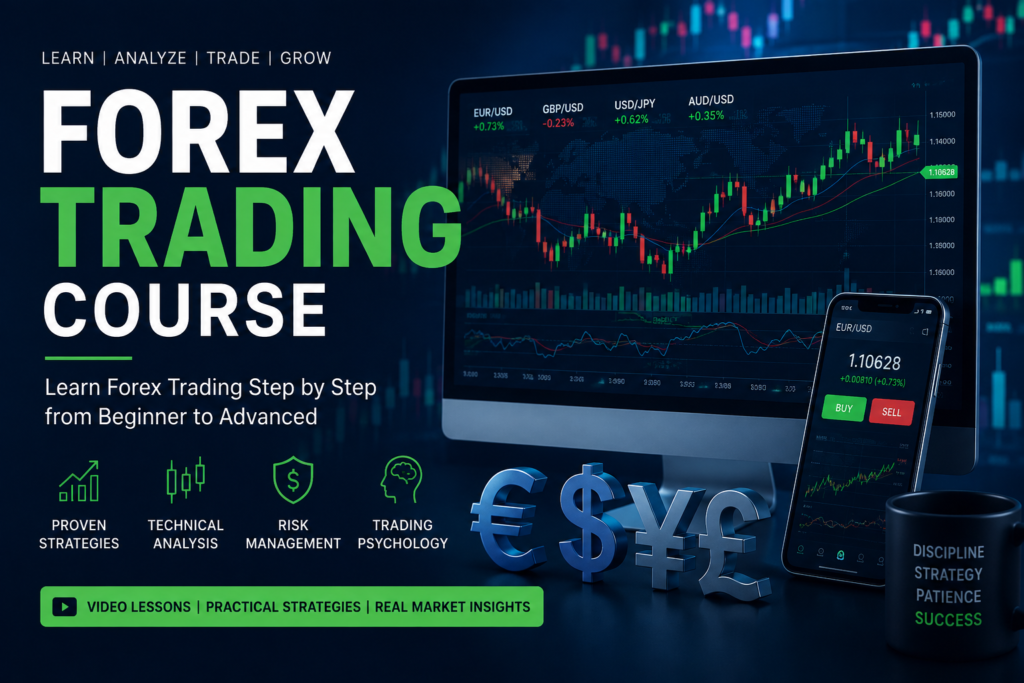
Forex Trading Course: Learn Forex Trading Step by Step
Forex trading has become a popular financial market for people interested in learning how currency markets work and how traders analyze price movements. However, successful trading requires knowledge, discipline, risk management, and consistent practice.
Our Video Forex Trading Course is designed to provide a structured learning experience through practical video lessons. Whether you’re completely new to Forex or want to improve your existing trading knowledge, the course helps you understand the fundamentals of Forex trading and develop a systematic approach to market analysis.
Risk Disclaimer: Forex trading involves substantial risk and can result in the loss of your capital. This course is for educational purposes only and does not guarantee profits or provide personalized financial advice.
What Is Forex Trading?
Forex, short for foreign exchange, is the global market where currencies are traded against each other. Currency pairs such as EUR/USD, GBP/USD, and USD/JPY represent the relative value of one currency against another.
Traders attempt to analyze market movements and manage positions based on their trading strategies and risk tolerance.
Why Take a Video Forex Trading Course?
Learning through structured video lessons allows students to study concepts at their own pace and revisit difficult topics whenever needed.
A well-structured Forex course can help you:
- Understand how the Forex market works
- Learn currency pairs and market terminology
- Understand charts and price movements
- Learn technical analysis
- Study price action concepts
- Understand support and resistance
- Learn trading setups and strategies
- Develop risk-management skills
- Understand trading psychology
- Practice analysis before risking real money
What You Will Learn in the Course
1. Forex Trading Fundamentals
The course starts with the basic concepts beginners need to understand.
Topics may include:
- What is Forex?
- How the Forex market works
- Currency pairs
- Major, minor, and exotic pairs
- Bid and ask prices
- Spread
- Pips
- Lots
- Leverage
- Margin
- Trading orders
- Basic trading terminology
These fundamentals provide the foundation for more advanced lessons.
2. Understanding Forex Charts
Charts are essential tools for analyzing currency markets.
You can learn how to understand different chart types and timeframes, including:
- Candlestick charts
- Line charts
- Different trading timeframes
- Price movements
- Market highs and lows
- Trends
- Volatility
Understanding how price behaves on a chart is an important skill for technical analysis.
3. Technical Analysis
Technical analysis involves studying historical price and market data to identify potential patterns and scenarios.
The course can introduce concepts such as:
- Market trends
- Support and resistance
- Trendlines
- Chart patterns
- Candlestick patterns
- Breakouts
- Pullbacks
- Market structure
- Indicators and their limitations
The objective is not to predict every market movement but to develop a structured way of analyzing potential trading opportunities.
4. Price Action Trading
Price action focuses primarily on the movement of price rather than relying exclusively on indicators.
You can learn about:
- Candlestick formations
- Market structure
- Support and resistance
- Breakouts
- Rejections
- Trend continuation
- Reversal setups
- Entry and exit planning
Price action can be combined with other forms of analysis to develop a trading plan.
5. Trading Strategies
The course introduces students to different trading approaches and helps them understand how a strategy should be tested before being used with real money.
Topics may include:
- Trend-following strategies
- Breakout strategies
- Pullback setups
- Support and resistance strategies
- Scalping concepts
- Day trading concepts
- Swing trading concepts
No strategy can guarantee profits. Market conditions change, and historical performance does not guarantee future results.
6. Trading Sessions
Understanding major Forex trading sessions can help traders study when different markets are active.
The course can cover:
- Asian session
- London session
- New York session
- Session overlaps
- Market volatility
- Selecting suitable trading times
Students can then develop a routine that fits their strategy and schedule.
7. Risk Management
Risk management is one of the most important parts of Forex trading.
A trading strategy without proper risk management can expose a trader to significant losses.
The course covers concepts such as:
- Stop-loss orders
- Position sizing
- Risk-to-reward ratios
- Managing trading capital
- Avoiding excessive leverage
- Setting trading limits
- Maintaining a consistent risk approach
The goal is to help students understand that protecting trading capital is just as important as identifying potential opportunities.
8. Trading Psychology
Emotions can strongly influence trading decisions.
Common psychological challenges include:
- Fear
- Greed
- Overtrading
- Revenge trading
- FOMO
- Lack of discipline
- Moving stop-losses
- Taking impulsive trades
The course introduces techniques for developing a more disciplined and consistent trading mindset.
9. Demo Trading and Practice
Beginners should understand the importance of practice before committing real capital.
A demo trading account can allow students to practice:
- Reading charts
- Applying strategies
- Setting orders
- Managing positions
- Testing risk-management rules
- Recording trading results
Keeping a trading journal can also help identify recurring mistakes and improve decision-making.
10. Developing a Trading Plan
A professional approach to trading requires a clearly defined plan.
Your trading plan can include:
- Preferred currency pairs
- Trading sessions
- Trading timeframe
- Entry conditions
- Exit conditions
- Stop-loss rules
- Position-sizing rules
- Maximum acceptable risk
- Trading journal requirements
Having predefined rules can reduce emotional and impulsive decisions.
Who Should Take This Forex Course?
This Video Forex Trading Course can be useful for:
- Forex trading beginners
- Students interested in financial markets
- People learning technical analysis
- Aspiring day traders
- Aspiring swing traders
- Traders looking to improve their fundamentals
- Anyone who wants a structured Forex learning roadmap
You don’t need to be an experienced trader to begin. The course is structured to introduce concepts progressively.
Benefits of Learning Through Video Lessons
Video-based learning provides flexibility and convenience. Students can watch lessons according to their schedule and revisit important concepts multiple times.
You can:
- Learn at your own pace
- Pause and replay lessons
- Practice alongside the videos
- Review difficult concepts
- Build your knowledge step by step
- Combine lessons with demo trading practice
Start Learning Forex Trading
Forex trading is not a shortcut to guaranteed income. It requires education, practice, discipline, risk management, and an understanding of the possibility of loss.
Our Video Forex Trading Course provides a structured educational roadmap covering Forex fundamentals, technical analysis, price action, trading strategies, risk management, psychology, and practical market analysis.
If you’re serious about learning Forex, start with education and practice before putting your capital at risk.
Enroll in the Video Forex Trading Course
Learn Forex. Analyze the Market. Practice Your Strategy. Manage Your Risk.
Start your Forex learning journey with structured video lessons and develop the knowledge needed to approach the currency market more responsibly.