Artificial intelligence is becoming a normal part of how people write, create images, produce videos and communicate online. But as AI-generated content becomes harder to distinguish from human-created work, technology companies and regulators are looking for new ways to identify where digital content came from.
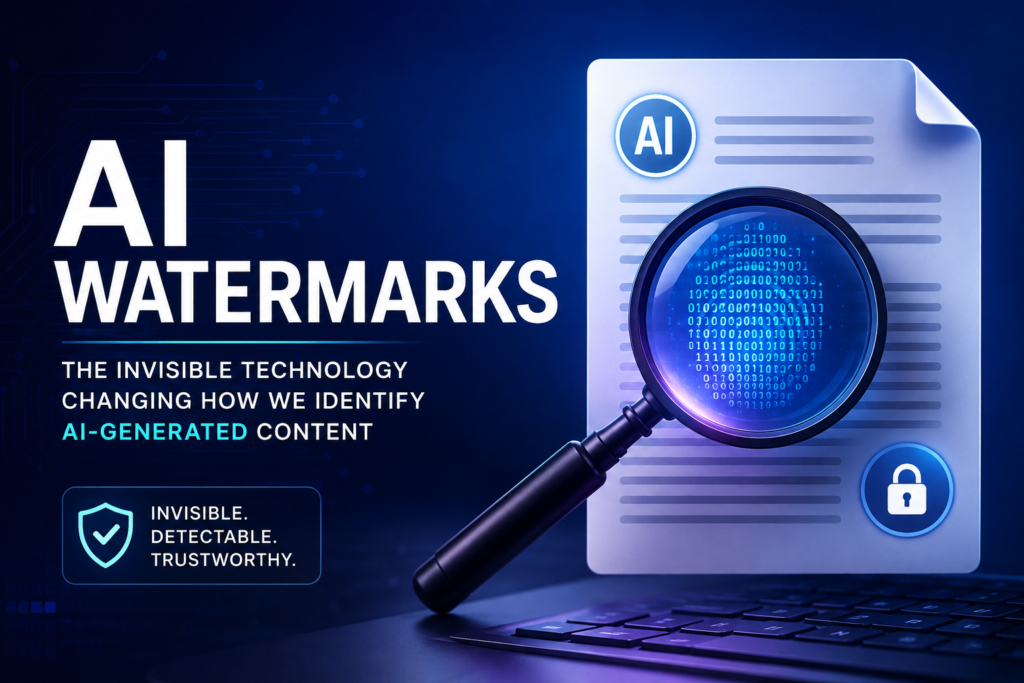
One of the latest developments is AI watermarking—a technology designed to place an invisible, machine-detectable signal inside AI-generated content.
Recent developments involving Anthropic’s Claude have brought renewed attention to the idea, particularly after the company introduced watermarking for AI-generated text as part of its efforts to meet transparency requirements connected to the European Union’s AI regulations.
What Is an AI Watermark?
An AI watermark is essentially a hidden signal that helps identify content produced or processed by an artificial intelligence system.
Traditional watermarks are often visible. For example, a photographer might place a logo across an image to show ownership. AI watermarks work differently.
With AI-generated text, the watermark can be created through the model’s choices while producing words and tokens. The resulting text still looks completely normal to a reader, but specialized detection technology may be able to identify statistical patterns associated with a particular AI system.
Anthropic’s approach has attracted attention because the watermark isn’t simply an invisible character inserted into the text. Instead, the technique can influence token selection while the AI is generating its response.
Why Is AI Watermarking Becoming Important?
The rapid growth of generative AI has created a major problem: How can people tell whether something was created by a human or generated by an AI system?
This question matters across many industries.
Schools may want to understand whether assignments were generated by AI. News organizations may need to verify the origin of information. Businesses may want to know whether documents were created or edited using AI. Social networks may also need better ways to identify synthetic content.
The issue becomes even more complicated as AI-generated material becomes increasingly realistic.
A photograph can look authentic. A video can appear to show a real event. And an AI-generated article can sound remarkably similar to human writing.
Watermarking is one proposed solution to this growing problem.
How Does Text Watermarking Work?
AI language models generate text one token at a time. At each stage, the model calculates probabilities for possible next words or tokens.
For example, if a sentence says:
“The sky was filled with…”
words such as “clouds,” “stars” or “birds” may have different probability scores.
A watermarking system can subtly influence these choices according to a hidden statistical pattern. Over a sufficiently long piece of text, those tiny choices can potentially create a detectable signature.
The important point is that the reader doesn’t necessarily see anything unusual.
Research and explanations surrounding current AI watermarking systems describe techniques that use statistical patterns in token selection rather than visible labels or obvious hidden characters.
AI Watermarks Don’t Necessarily Mean “AI Wrote Everything”
This is one of the most important distinctions.
A detected watermark doesn’t necessarily prove that an AI wrote an entire document from scratch.
For example, imagine someone writes a 1,000-word article themselves and then asks an AI system to improve grammar, rewrite several paragraphs or translate the article.
If the AI produces enough of the final wording, the resulting text could potentially contain the model’s watermark.
That means the watermark may indicate that an AI system processed or generated some of the content, rather than proving that the entire piece was originally created by AI.
This distinction could become particularly important in education, journalism, publishing and professional writing.
Watermarking Is Not Perfect
AI watermarking also has limitations.
Detection can become more difficult when the amount of text is very small because there are fewer word choices available for the statistical system to analyze. Current discussions of AI watermarking also highlight questions about how well watermarks survive substantial rewriting or paraphrasing.
This means an AI watermark shouldn’t automatically be treated as an infallible lie detector.
A detection result needs context.
For example, a document that contains evidence of AI processing doesn’t necessarily tell us:
- Who originally wrote it
- How much AI assistance was used
- Which parts were written by a human
- Whether the AI was used for editing or translation
- Whether the final content was substantially rewritten afterward
These questions are likely to become increasingly important as watermarking technology develops.
Why Claude’s Watermarking Matters
Anthropic’s implementation has generated significant discussion because the company says watermarking is being introduced at the model level.
Reports indicate that the technology is intended to apply across Claude’s newer models and products rather than functioning simply as a user-selectable setting. Anthropic has also said that its approach is connected to compliance with transparency requirements under the EU AI Act.
The move demonstrates how AI regulation is beginning to influence the technical design of AI models.
Instead of simply asking users to label AI-generated content themselves, regulators and technology companies are increasingly exploring automated methods for establishing content provenance.
The Bigger Debate: Transparency vs. Privacy
AI watermarking raises an interesting question.
Should people always know when AI has been involved in creating digital content?
There are strong arguments on both sides.
Supporters say watermarking could help reduce misinformation and make the digital environment more trustworthy. If people can identify AI-generated content, they may be better equipped to evaluate what they see online.
Critics, however, worry about false positives, incomplete detection and the possibility that people could interpret a watermark as proof of something it doesn’t actually prove.
There is also a philosophical question surrounding AI-assisted work.
If a writer creates an article, uses AI to improve its grammar and then publishes the final version, should that be considered AI-generated content?
What about translation?
What about brainstorming?
What about correcting spelling?
Watermarking technology alone cannot answer these questions. Those are questions about policy, ethics and the definition of authorship.
AI Watermarks Could Become a New Digital Standard
The development of AI watermarking suggests that content provenance could become an increasingly important part of the internet.
In the future, we may see more systems designed to indicate whether content was:
- Created entirely by a human
- Generated by AI
- Edited using AI
- Translated by AI
- Modified using an AI-powered tool
- Produced by a combination of humans and AI
This could eventually become similar to metadata and other forms of digital information that operate behind the scenes.
The goal isn’t necessarily to stop people from using AI. Instead, the objective is to make AI involvement easier to identify.
What This Means for Content Creators
For bloggers, journalists, marketers, students and other creators, the rise of AI watermarking is a reminder that AI-assisted content is entering a new phase.
Simply copying AI output and publishing it without review is increasingly risky—not only because of possible detection, but because AI-generated material can contain factual errors, outdated information and weak reasoning.
The better approach is to use AI as a productivity tool while maintaining human oversight.
Creators should verify important claims, add original analysis, edit the writing and make sure the final work actually reflects their intended message.
AI can help produce content faster, but responsibility for the published result still matters.
The Future of AI-Generated Content
AI watermarking is still an evolving technology, and there are significant technical and policy questions that remain unanswered.
The biggest challenge may not be creating a watermark. It may be creating a system that is accurate, reliable, transparent and fair.
If watermarking becomes too easy to misinterpret, it could create new problems instead of solving existing ones.
But if companies can develop reliable provenance systems, they could provide a valuable layer of transparency in an internet increasingly filled with synthetic content.
The concept behind AI watermarking is simple: make AI-generated content identifiable without changing what the user sees.
How well that idea works in the real world will depend on the technology, the detection systems and how responsibly people interpret the results.
As AI continues to become part of everyday digital life, knowing where content came from may become just as important as knowing what the content actually says.
The future of the internet may not be completely human or completely AI. It will likely be a mixture of both—and technologies such as AI watermarking could help us understand which is which.
- UK Pensioners Won’t Pay Tax Just Because State Pension Tops Tax Threshold, John Healey Says
- Apple Could Be Working on Multiple Foldable iPhones: What We Know So Far
- Quantum Computers Just Passed a Test Classical Computers Fundamentally Can’t
- 5 Early Web Programming Languages That Still Power the Modern Internet
- Xanadu Secures $195 Million From Canada to Build the Future of Quantum Computing